Mud-Terrain Tires
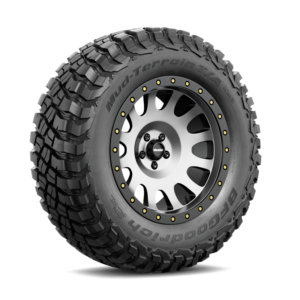
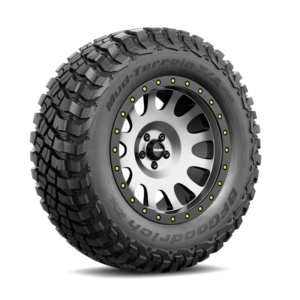
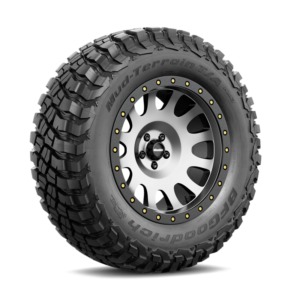
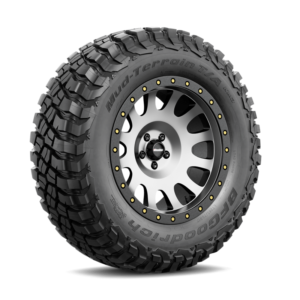
Mud-terrain tires are purpose-built for traction where there is no pavement. The defining feature is the tread void ratio: the huge gaps between tread blocks let the tire dig down through mud to find something solid, and let the mud pack out and fling clear as the wheel turns instead of filling in and turning the tire into a slick. The large blocks themselves are what bite into rock and rutted dirt.
The other half of a real mud-terrain is the sidewall. Aggressive sidewall lugs give you traction from the side of the tire when you are in a rut, and a three-ply sidewall construction resists punctures from rock edges when you air down. If you air down to 12 to 18 psi for trail traction, sidewall construction is the specification you should be reading first.
Be realistic about the tradeoffs on pavement:
Noticeably louder, especially between 45 and 65 mph, and the noise grows as the tire wearsShorter tread life, commonly 30,000 to 40,000 milesReduced wet pavement braking compared to an all-terrain, because there is less rubber touching the roadA measurable fuel economy hit from weight and rolling resistanceFaster irregular wear if you do not rotate on a strict scheduleIf your truck is a daily driver that sees mud a few weekends a year, a rugged-terrain tire will make you happier. If you actually get stuck for a living or for fun, nothing else does this job.
Showing 1–12 of 172 results






Before you buy
Mud-Terrain Tires: the questions people ask
How do I read a tire size?
Metric sizes give section width in millimetres, then aspect ratio as a percentage of that width, then rim diameter in inches. So 275/60R20 is 275mm wide with a sidewall 60 percent of 275mm tall on a 20 inch wheel. Flotation sizes are simpler: 35x12.50R20 is 35 inches tall and 12.5 inches wide on a 20 inch wheel. Every listing here also publishes the overall diameter worked out for you.
Will a bigger size fit without a lift?
Usually one size up over stock clears on a half ton truck with a leveling kit. Going from a 33 inch to a 35 inch tire almost always needs a leveling kit plus trimming at the front bumper corners. 37 inch tires need a real lift and normally a re-gear to get the drivability back.
What do load index and speed rating mean?
Load index is the weight one tire carries at its rated pressure. Speed rating is the sustained speed it is certified for. Never fit a tire with a lower load index than the placard in your driver door jamb calls for. On a truck that tows, going under the placard rating is the commonest cause of a tire failing under load.
Do tires arrive mounted?
Loose tires ship on their own and need a local shop to mount and balance them. Wheel and tire packages ship mounted, balanced and ready to bolt on.
How fast do orders ship?
Orders ship from a United States warehouse, normally within 1 to 3 business days of clearing. Orders over $199 ship free, and below that a flat rate is shown at checkout before you pay. Tracking is emailed as soon as the shipment is created.
What can I return?
Unmounted, uninstalled parts in original packaging can be returned within 30 days. A wheel that has had a tire mounted on it, and a tire that has been fitted, cannot be returned because neither is new any more. That is why we check the fitment data on every order against the vehicle you give us before it ships.
Can someone check fitment for me before I order?
Yes, and it costs nothing. Send us the year, make, model, trim and what is on the vehicle now, and we will tell you what fits, what will rub and what it takes to clear.
Keep reading